The Business of Philanthropy
Philanthropy is shifting from informal giving to a structured form of capital allocation defined by governance, accountability and measurable outcomes. As global wealth concentrates and public funding declines, donors are becoming more strategic, data driven and internationally mobile, with approaches such as MacKenzie Scott’s trust based, unrestricted funding accelerating change across the sector.
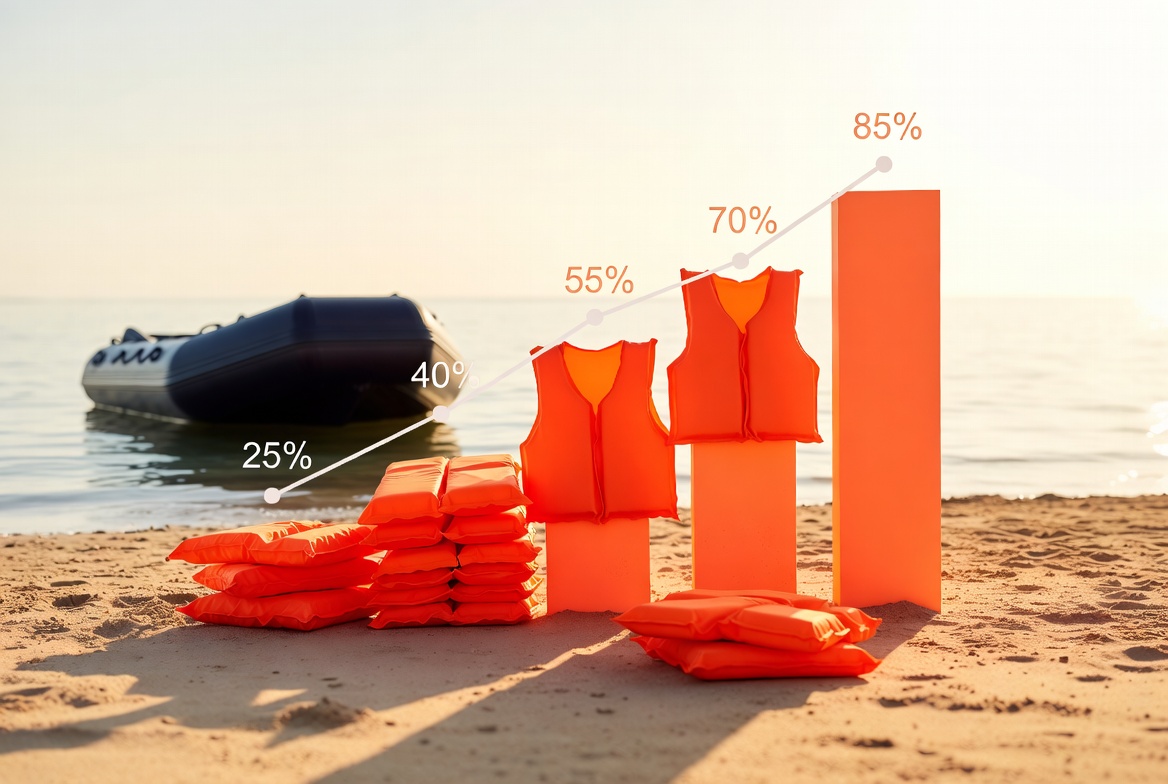
Life jackets on a beach reminiscent of Ai Wei Wei
Philanthropy is undergoing a fundamental shift
What was once treated as a discretionary and largely unquestioned expression of wealth is now being examined as a form of capital deployment that demands governance, accountability and measurable impact. As private wealth becomes more concentrated and public funding retreats, the role of philanthropy has moved from the margins to the centre of economic and social debate.
This shift, exemplified by approaches such as MacKenzie Scott’s (Yield Giving) large scale, trust based and unrestricted giving, forms the core of the Citywealth Forum brief, where philanthropy is being examined as a strategic deployment of capital rather than an adjunct to wealth. Scott has given more than $26bn through her platform Yield Giving to over 2,700 organisations, typically without restrictions on how funds are used.
The United States continues to dominate global charitable giving, accounting for an estimated 40 to 50 per cent of worldwide donations, with more than $450 billion given annually. Total global philanthropic giving is estimated at between $700 billion and $1 trillion. At this scale, philanthropy is no longer a side conversation about generosity. It has become a structural force, raising legitimate questions about oversight, effectiveness and sustainability.
These issues will be debated at the Citywealth Forum on 12 May in the panel The Business of Philanthropy, moderated by Matthew Briggs, Partner at Boyes Turner. The panel brings together Anna Josse, CEO and Co Founder of Prism the Gift Fund, Anna Tylor, Chairwoman of RNIB, and Rennie Hoare, Partner and Head of Philanthropy at C. Hoare and Co, to examine what best practice now looks like in an era of impact driven, data backed giving.
Philanthropy moves into mainstream wealth planning
Natalie Pinon, Interim CEO of National Philanthropic Trust UK, sets out how giving is being pulled into wider financial planning and shaped by geopolitical risk, cross border complexity and heightened expectations of proof.
“We are seeing a shift towards a more strategic approach that sits within broader financial planning, rather than treated as a separate activity, particularly as wealth becomes more complex and increasingly international. This is being shaped by a more uncertain geopolitical environment, which is also driving heightened consideration around decision-making. Conflicts such as the war in Ukraine and the Middle East crisis have led to mobilisation of funds toward humanitarian relief such as support for displaced families, healthcare of children in conflict zones, but also towards helping to build resilience with education crisis zones, refugee support and integration and food security.”
“Different jurisdictions are introducing new rules around tax and giving, while events such as the Middle East crisis are influencing both where donors base themselves and how they direct their contributions. For those giving through donor-advised funds, it’s a balance between setting a long-term vision and acting quickly where there is immediate need. As an example, a donor focused on education might fund long-term scale up or broadening of a proven school model but also deploy charitable grants quickly to support displaced children during a conflict or humanitarian crisis.
Optics require resources
“While high-profile examples have brought attention to more flexible charitable funding models, most donors still want clarity on how their philanthropic capital is being used and what it is achieving. At the same time, charities are facing rising demand and cost pressures, so are having to work harder to demonstrate impact and build trust with a reduced pool of donors who are more active and more discerning. For charities this is about capacity constraints when resources are already stretched. While there is a shift towards greater transparency and accountability, meeting these expectations requires investment in reporting capabilities and such skills that not all organisations are currently resourced to deliver.”
“We are increasingly having conversations with donors about how they plan their giving so that contributions are ringfenced for charitable purposes, while also ensuring they can deploy those funds over time in a way that maximises their impact and aligns with their philanthropic goals. For instance some donors see philanthropy like portfolio management with a mix of long term commitments and a strategic approach 5+ years, with short term responsive funding and grants.”
“As the largest intergenerational wealth transfer in history gathers pace, this is only set to accelerate. For the next generation of donors, philanthropy is not an afterthought to wealth planning, it is a core part of it.”
Oversight, due diligence and further pressure on charities
A more disciplined culture of giving has brought sharper debate about high profile models of unrestricted funding and how oversight works when large sums move quickly. Anna Josse, Co-Founder of Prism the Gift Fund focuses on due diligence, sustainability and the rise of cross border giving.
Josse said. “With the ongoing cost of living crisis and recent government cuts now affecting the charitable sector, more charities are struggling to cover their expenses and are being forced to close. Recognising the need for a sustainable solution, the government realise they need a relationship with philanthropists to help maintain the charitable sector. This initiative is underway, and time will tell whether funding will successfully reach the charities most in need. Despite some high-net-worth individuals leaving the country due to changes in tax legislation, many remain and continue to provide vital support to charities. Prism has seen an increase in Americans relocating to the UK, and this is an opportunity for smart charities to capitalise on this moment of time. The concept of cross border giving is on the increase and so Prism, as a leader in this field, is establishing funding mechanism to capture donors whenever they may be globally.”
The practical challenge Prism the Gift Fund will tackle
While the appetite for cross border giving is growing, the reality is that international philanthropy remains structurally complex. Donors are often navigating systems that were never designed to operate seamlessly across jurisdictions. One of the most immediate barriers is tax treatment. Each country operates its own framework for charitable relief, and these rarely align. There is also the issue of charitable recognition. Not all organisations are formally recognised outside their home country, meaning a legitimate charity in the UK may not qualify as such under US rules, and vice versa. This lack of mutual recognition creates friction and, in some cases, prevents donations altogether.
Layered on top of this are currency, regulatory and compliance challenges. Exchange rate volatility can affect the value of a gift, while anti money laundering rules, due diligence requirements and reporting obligations add administrative burden for both donors and recipient organisations. For charities, particularly smaller ones, these hurdles can be prohibitive.
Taken together, these factors mean that, despite strong donor intent, cross border giving often requires specialist structures to function effectively. Without them, the process can be inefficient, opaque and, in some cases, discouraging.
Donors behave less like patrons and more like allocators of capital
Matthew Briggs, Partner at Boyes Turner, describes how donor behaviour is changing and what that means for charities seeking support.
“Philanthropy is becoming far more intentional, with major donors behaving less like patrons and more like impact-driven investors. The sector is shifting toward data backed giving, a deeper understanding of how an organisation’s work creates change, and a growing appetite for solutions that address root causes rather than symptoms. MacKenzie Scott has shown that rigour and trust can coexist: her large, unrestricted grants reward organisations with proven credibility and community impact, demonstrating that donors don’t need to impose heavy frameworks when the fundamentals are strong. With routine giving in decline and the donor pool narrowing, charities are being pushed to articulate their value with far greater precision, evidence their effectiveness, and deploy capital with real strategic discipline. The organisations that thrive will be those that treat impact as a core competency rather than a marketing line, and that can show how their work contributes to long term, systemic change.”
Impact driven investing
Impact driven investors generate financial returns through a range of familiar instruments, applied to projects with clear social or environmental outcomes. Beyond green bonds, returns can come from infrastructure investments such as renewable energy assets that produce steady income through long term contracts, private lending where interest is earned from supporting mission led businesses, or equity stakes in social enterprises that grow in value over time. Other models include affordable housing, where rental income provides yield, and natural capital investments such as forestry, which generate revenue through timber or carbon credits. In each case, the financial mechanics are conventional, but the capital is deliberately directed towards activities that deliver measurable impact alongside profit.
How good intent becomes delivery
Lisa Cornwell, Partner, Leader Private Clients and Family Offices, PwC Switzerland argues that outcomes increasingly depend on governance, operating models and organisational strength, not simply what is funded.
“Philanthropy and philanthropic capital are becoming more structured and outcome oriented. Among larger donors and foundations, the focus is shifting from simply allocating funds to how capital is governed, deployed, and used to achieve lasting results. Evidence and learning increasingly shape donor expectations, but there is also growing recognition that impact depends as much on organisational strength as on funding choices. As a result, we see donors becoming more flexible in how they fund proven interventions, increasingly combining their financial support with investment in leadership, systems, and resilience within charities themselves. Philanthropic capital is therefore playing a more catalytic role, helping organisations build capacity, test approaches, and generate evidence that can be scaled, often alongside public partners.”
Diego Estrada Mendoza, Senior Manager, International Development, PwC Switzerland said. “A clear example can be seen in sectors such as education, where foundations work with governments and delivery partners to scale evidence-based programmes, by strengthening teacher training, improving the use of data in classrooms, and supporting implementation systems that allow programmes to be delivered consistently at scale.”
Cornwell added. “This reflects a more strategic model of giving, where outcomes depend not only on what is funded, but on how organisations are enabled to deliver, with governance, operating models, and decision-making quality increasingly determining whether good intent translates into sustained impact.”
Cultural philanthropy, discretion and reputational caution
Dr Jacqueline Nowikovsky, Founder, N Fine Art describes how reputational sensitivity and a preference for defined initiatives are reshaping cultural giving.
“As the ultra-contemporary market cooled down and museums exercise greater curatorial agency, philanthropy is now a collaborative dialogue: institutions are clearer about what they want, and collectors are more thoughtful about what they offer. At the same time, reputational sensitivity has sharpened considerably. Especially particularly younger collectors and Gen Z are wary of public association where there is potential for backlash, whether environmental or ethical, and are opting for discretion over visibility, What I see instead is a shift toward precision and purpose: clients take pride in funding clearly defined initiatives, whether underwriting a specific exhibition, supporting a publication or investing in education programmes where impact is tangible and generational. Increasingly they also favour legacy structures over passive giving, like endowing curatorial roles or named positions that embed their support within the intellectual fabric of an institution. In this landscape, philanthropy is less about access or vanity, and more about alignment, causes close to the heart, authorship and measurable, cultural impact.”
A more demanding donor base and a more accountable sector
Fiona Noon, Head of Private Wealth & Family Office, Isle of Man and Vicky Kinrade, Executive Director in trust company, Equiom‘s Private Wealth and Family Office team, describe how donor expectations are tightening and how families are embedding giving into wider structures.
“Modern philanthropy is being shaped by a new generation of donors who expect impact evidence, strategic alignment and long term relevance. Families are embedding giving into their wider wealth structures, engaging the next generation early and demanding clearer accountability. Charities are rising to this challenge by adopting more sophisticated measurement frameworks and governance models suited to an increasingly discerning donor base.”
While donor expectations are becoming more exacting, there is also a growing recognition that lasting impact depends on trust, flexibility and shared responsibility.
Flexibility and trust in tackling entrenched issues
Andrew Robinson MBE, Head of Market Development, CCLA focuses on trust, flexibility and collaboration, arguing that systemic problems require shared ownership and time to learn. CCLA is a UK fund manager that primarily serves charities, religious organisations, and public bodies. Founded in 1958, it focuses on long term, responsible investing with a strong emphasis on environmental, social and governance issues.
Robinson said. “At CCLA we are a signatory of IVAR’s open and trusting principles (Institute for Voluntary Action Research a UK research and policy body focused on charities and funding) and believe that voluntary organisations need flexibility to determine what and how to most benefit the communities they are serving.”
“Adopting a collaborative approach works as evidenced by the Care Leavers Programme, run by UK Community Foundations, of which CCLA is a founding supporter. Young people leaving care and transitioning to adulthood face a myriad of issues as their support net falls away. When donors provide capital, whether for this or any other programme, they are often providing funding for complex issues that are systemic in nature.”
Systemic issues include housing instability, including homelessness or being placed in unsuitable accommodation, as formal support ends. Care leavers often face gaps in education and employment, with lower attainment and fewer pathways into secure work. Many also carry significant mental health challenges linked to earlier trauma and instability, compounded by the loss of consistent support. Crucially, they lack the informal networks most young people rely on, with no family safety net for guidance, financial help, or opportunities.
“Systemic issues require a systemic response. Bringing together an ecosystem of knowledge and support as we have done for the Care Leavers Programme, from people with lived experience, charities on the ground, to local authorities, and employers, has enabled a more rounded and place-based approach which can flex to provide the very specific support required by the individual. This means less ownership from any one party and greater collaboration as a whole. It also means factoring in time for the project to evolve, incorporating learnings and being prepared to adapt implementation to truly deliver the real long-term impact that we all aspire to see.”
Bigger, bolder and more disruptive philanthropy
Harriet Kwarteng, Director and solicitor at KPMG Law, who has a background in charities, argues that impact and data are shaping strategy, but that a second trend is a push toward larger, more ambitious, more disruptive projects.
“As an advisor to both philanthropists and charities, I certainly agree that impact and data are key trends which are shaping the respective strategies of my clients. A weak economic forecast and an increase in AI will embed these trends in the short to medium term.”
“However, equally key themes I am observing are ‘bigger, bolder, more disruptive’ where clients are focused on solving wide societal and international problems through their charitable activities. This is being borne out in current client projects. One is setting up a UK branch of an international charity aimed at improving healthcare worldwide with AI. Another is improving the lives of the most disadvantaged communities through improving global supply chains and ending modern slavery through collaboration with leading academic institutions.”
Tackling big moonshots
“Ad hoc ‘habitual’ giving by a wide donor base may be on the decline but strategic, ambitious, and collaborative philanthropy from a smaller base is on the rise and I predict this will be here to stay. A good example in the public domain and which was the source of inspiration for one of the projects I cited is the Allen Institute, founded by Paul Allen, Microsoft co-founder. Of particular resonance is their mission: ‘We remain audacious in our commitment to tackling big, moonshot, questions in basic science.’”
Trust based funding, cross border diversification and tax planning
Joe Crome is Head of Business Development, CAF American Donor Fund at CAF (Charities Aid Foundation). He holds the Chartered Advisor in Philanthropy (CAP®) designation from The American College of Financial Services. Crome sets out a longer view that combines trust based philanthropy, cross border diversification and the practical pressures of inflation and tax rules.
“One of the biggest trends in recent times has undoubtedly been Mackenzie Scott’s approach to her giving, which has inspired a movement known as Trust Based philanthropy. The idea is to shift the power dynamic; rather than demanding onerous restrictions and reporting requirements from charities, the donor instead entrusts high impact organisations with unrestricted funding that enables the nonprofit to focus on their mission and important work for the long term, producing better (and more efficient) outcomes for beneficiaries.”
“The geopolitical challenges we see globally have impacted all parts of life, including philanthropy. Where previously foundations and major donors may have been comfortable basing their charitable giving from one jurisdiction, in the past year we have seen a huge migration of assets around the world as philanthropists seek to de-risk and diversify by creating structures in multiple countries with substantial amounts of capital. I anticipate this will continue to be a major theme throughout 2026.”
“As inflation hits and costs rise, CAFs recent UK Giving report found that six million fewer people donate to charity today than ten years ago, with one in five saying that cannot afford to give. Despite these challenges, £14bn was donated by the UK general public last year, and our research shows an extra £8bn is given annually by UHNW. The good news is that wealthy people are stepping up and giving more, and the work I do with colleagues in the private wealth industry shows me that the enthusiasm and interest in philanthropy can continue to drive new donors and larger donations to support the vital work of charities. Looking ahead, expect to see growth of donor advised funds, gifts of non-cash assets, and increasing involvement of the next generation in family giving strategies.”
“I lead CAFs Transatlantic business so most of my clients are American and my comments on diversity and derisking apply to them. Donors are adding new structures, so rather than just choosing to deploy their giving through a Private Foundation or Donor Advised Fund (DAF), they are increasingly choosing both, in some cases multiple DAFs as well as using Community Foundations for their local giving. Spreading risk around multiple structures and jurisdictions may just be the biggest theme I am seeing.”
“It’s also worth noting for American donors that the One Big Beautiful Bill introduced a number of amendments to U.S charitable gift deductions starting from 2026. The changes, which particularly impacted those in the highest tax bracket due to a new floor and cap on deductions, make it more important than ever to carefully plan your timing and assets ahead of making significant charitable gifts. How this impacts giving behaviour this year is certainly one to watch.”
Unrestricted funding and simplifying structures
Rennie Hoare, Head of Philanthropy at C. Hoare & Co, UK’s oldest, family-owned private bank also chairs Hoares Trustees Limited for the Master Charitable Trust, their donor advised fund, describes two trends, advisers unlocking unrestricted funding and families simplifying governance through donor advised structures.
Hoare said. “The first trend is the power of advisers to unlock unrestricted funding. Over the last year, relationship managers within the Master Charitable Trust (MCT) have been routinely asking donors whether they genuinely intend a grant to be restricted. In many cases, donors had not realised that their request could be interpreted in that way. As a result, over 80 per cent of grants are now unrestricted. Unrestricted grants are incredibly powerful. What has been striking is how comfortable many donors are with this approach; they simply need to be asked the right question.”
“Second, we are seeing charities and families actively simplify their governance structures. We recently moved our own 40 year old family charitable trust, the Golden Bottle Trust, into the MCT. Today, over 10 per cent of our giving funds have been created in this way. Using a donor advised fund broadens the range of charities one can support, removes the burden of trustee responsibilities, and retains appropriate controls around grant making. More families are appreciating the freedom this creates; allowing them to focus their time and energy on identifying and supporting great charities, rather than managing structures.”
The economics of philanthropic choice
Joshua S. Rubenstein, Partner and National Chair of Katten‘s Private Wealth Department, a New York law firm, frames the shift through the lens of wealth concentration, transfer taxes and which structures work best in practice.
“As a small number of individuals have accumulated unfathomable amounts of wealth, it makes perfect sense that a large number of them, once they have provided whatever they consider to be ‘enough’ for their families, are making uber significant, impact driven charitable gifts, particularly in countries like the United States that impose (at the federal and regional levels) death time transfer taxes in the amount of roughly 50% (at the maximum levels of wealth). Would you prefer to give half of what you have to the government or to charity? Charities are generally speaking far more efficient at spending their dollars than governments. Overhead covered by charitable dollars can be as little as 10%, while overhead covered by tax dollars can be 70% or more. And if you get a charitable income, gift or estate tax deduction for your charitable donation, the exact same amount expended can be so much more impactful.”
Conclusion
Read together, these contributions point to a clear direction of travel. Philanthropy is being treated less as a social gesture and more as a governed allocation of resources. Donors are asking sharper questions. Charities are being pushed to evidence delivery and value. Advisers are shaping structures and unlocking flexibility. Cross border giving is rising.
As reflected both in the Citywealth Wealth Forum brief and in the influence of MacKenzie Scott’s trust based, unrestricted model of giving, the central issue is no longer whether philanthropy matters, but how effectively it is structured, governed and deployed as a form of capital in an increasingly complex global environment.
The debate now is not whether generosity exists, but whether the systems around it are strong enough to protect impact and public confidence as the sums grow.
Read about the upcoming Citywealth Forum 12th May here
Key Takeaways
- Philanthropy is shifting towards structured capital allocation, demanding governance and measurable outcomes.
- Donors are adopting strategic approaches influenced by geopolitical risks and expecting proof of impact.
- The Citywealth Forum will discuss best practices in the ‘Business of Philanthropy’ with notable speakers.
- Unrestricted funding models, like those of MacKenzie Scott, are gaining traction, allowing charities to focus on their core missions.
- Donor expectations are rising, and charities must demonstrate value and effectiveness amidst this changing landscape.
- Read more about Yield Giving gifts here
Subscribe to the Citywealth Weekly Newsletter to learn more about Private Wealth Management.
Table of contents
- Philanthropy is undergoing a fundamental shift
- Philanthropy moves into mainstream wealth planning
- Optics require resources
- Oversight, due diligence and further pressure on charities
- The practical challenge Prism the Gift Fund will tackle
- Donors behave less like patrons and more like allocators of capital
- Impact driven investing
- How good intent becomes delivery
- Cultural philanthropy, discretion and reputational caution
- A more demanding donor base and a more accountable sector
- Flexibility and trust in tackling entrenched issues
- Bigger, bolder and more disruptive philanthropy
- Tackling big moonshots
- Trust based funding, cross border diversification and tax planning
- Unrestricted funding and simplifying structures
- The economics of philanthropic choice
- Conclusion
Read more:
IFC insights: Indian wealth management
The Global Migration Shake-Up: Why the Wealthy Are Moving
Citywealth Leaders List: Top 30 Immigration Advisors 2026
Citywealth Forum 2026 – Speaker: Matthew Briggs, Boyes Turner
60 seconds with Matthew Briggs, Boyes Turner
Citywealth Forum 2026 – Speaker: Matthew Briggs, Boyes Turner


Tens of thousands leave the Gulf for the UK, for now
Tens of thousands of residents have left the Gulf amid escalating tensions, with many British and international families temporarily returning to the UK while the situation unfolds.
When taxes rise, wealth moves: a new era for UK and US succession planning
As UK inheritance tax rules expand and US policy evolves, advisers are reassessing how internationally mobile families should approach wealth, residence and succession planning.