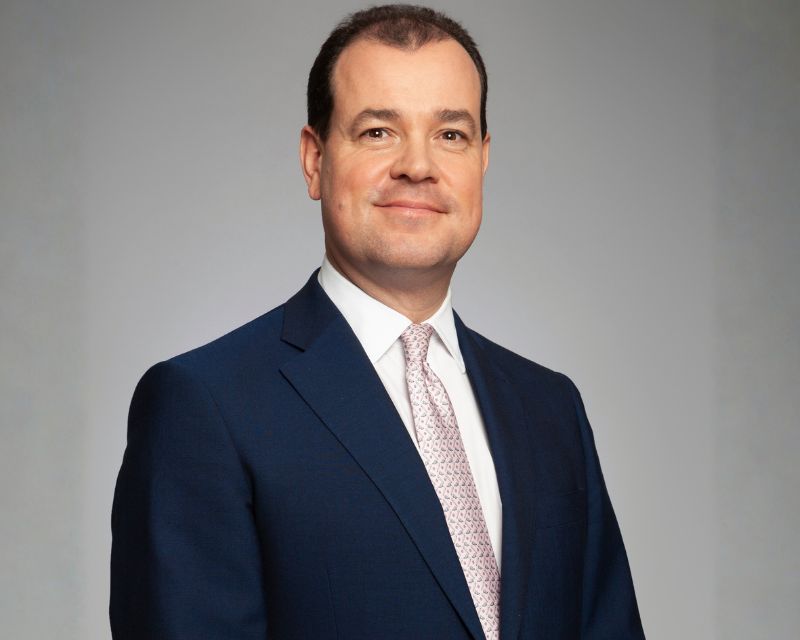
Citywealth Quick Insight Series on Crypto & Digital Asset Trends – Dmitry Tokarev, Bron
This week’s Quick Insight Series on Crypto & Digital Asset Trends is dedicated to Dmitry Tokarev, Founder of Bron.

What’s your current assessment of the digital asset market, and how is macroeconomic or regulatory uncertainty affecting sentiment among private wealth clients?
I believe the regulatory overhang is largely behind us. I’ve been in crypto for well over a decade, and in the early years almost every conversation started with the same concern: “What if governments ban Bitcoin?” That objection has effectively disappeared. What we do see today is significant macroeconomic turbulence, with inflation being the dominant factor. Many private wealth clients feel that real inflation is meaningfully higher than what headline figures suggest. This is driven by several factors — including substantial changes in CPI methodology over time (CPI according to 1970s standards would have shown over 15% inflation during 2021-2024 in the US) and a widening income gap between the top 1% and the rest of the population, which has pushed prices for assets and luxury goods substantially higher. As a result, private wealth clients are increasingly looking to diversify into assets with finite supply and limited external control over issuance — most notably digital assets and gold — as a hedge against monetary debasement.
How are recent policy changes in the U.S., EU, or Asia influencing crypto adoption or caution in the private client space?
Digital assets are benefiting from a strong tailwind driven by both monetary policy and regulatory change. Since 2009, the global financial system has effectively been in a prolonged period of monetary expansion — first in response to the 2008 financial crisis, then to fund pandemic-era stimulus, and more recently as governments struggle to rein in structurally large budget deficits. Against this backdrop, private wealth globally is increasingly reallocating toward hard assets such as gold, real estate, and — despite their volatility — digital assets, which offer scarcity and independence from discretionary monetary supply. At the same time, policy developments are becoming more supportive. A more crypto-friendly administration in the U.S., greater regulatory clarity in Europe, and active currency digitisation initiatives in countries such as Brazil and India are collectively accelerating adoption. These shifts are clearly being felt in the private client space and are translating into higher allocations to digital assets within diversified portfolios.
What role are digital assets currently playing in the portfolios of HNWIs and family offices — speculative, hedging, or strategic?
Among HNWIs and family offices, the role of digital assets increasingly depends on generational dynamics. Age is one of the strongest predictors of whether digital assets are viewed as speculative, hedging, or strategic. Older cohorts — broadly the Silent Generation and Baby Boomers, who control over 60% of global private wealth, tend to have higher trust in banks and government institutions, and correspondingly substantially lower confidence in digital assets. By contrast, Millennials and Gen Z display significantly lower trust in traditional institutions and a much more optimistic view of digital assets. Among these groups, digital assets are increasingly seen as a strategic allocation rather than a speculative trade. As the largest intergenerational wealth transfer in history accelerates from Baby Boomers to Millennials and Gen Z, the role of digital assets in private portfolios is naturally expanding. Five years ago, most demand was predominantly speculative. Today, conversations are far more strategic — focused on long-term wealth allocation, intergenerational planning, and the use of digital assets as a hedge against inflation and monetary debasement.
How are wealth managers integrating crypto and blockchain-based products into diversified portfolios for their clients?
Leading wealth managers are increasingly integrating digital assets into diversified portfolios, typically as small (1-5%) but deliberate allocations within model portfolios. Firms such as BlackRock, Fidelity, and UBS now explicitly frame crypto as a strategic diversifier or inflation hedge implemented through regulated vehicles such as ETFs. The conversation has largely shifted from whether crypto belongs in portfolios to how it should be sized, structured, and custodied. However, the largest transformation is still ahead. Clients who are native to crypto markets increasingly expect features that traditional finance does not yet offer: 24/7 trading, real-time settlement, and instruments such as perpetual futures without expiration dates. For younger demographics in particular, it is increasingly unintuitive that equities trade only during limited hours or that leverage is restricted to dated futures contracts. As this cohort becomes a larger share of private wealth, these expectations are likely to drive further convergence between traditional wealth management and crypto-native market structures.
Are there specific tokens, protocols, or segments (DeFi, stablecoins, real-world assets) that you see gaining traction among private investors in 2025?
In 2025, stablecoins clearly emerged as the most widely adopted segment of digital assets. However, the truly transformative wave is still ahead and remains underappreciated: tokenised equities and bonds. As of the end of 2025, outstanding tokenised securities stand at roughly $15bn — a negligible fraction of global equity and fixed-income markets. Yet the logic for tokenisation is compelling: it dramatically lowers issuance, settlement, and operational costs while expanding access. The efficiency gains are already visible. Platforms like Copper Clearloop do billions in settlement volumes daily without almost any backoffice staff while banks employ thousands just for the same task. Looking forward, demand from younger, digitally native investors for 24/7 markets and near-instant settlement is likely to push equities and bonds on-chain. When that transition accelerates, it will meaningfully benefit the Layer-1 networks best suited to support institutional-grade, high-throughput financial markets, such as Ethereum, Solana and Canton Network.
How do you see the evolution of ESG frameworks and sustainability intersecting with blockchain and digital assets?
ESG considerations are often raised in discussions about digital assets, but they require more precise and differentiated analysis. The majority of blockchains that underpin today’s transactional activity — such as Ethereum, Solana, and Tron — operate on proof-of-stake consensus mechanisms. These networks are highly energy-efficient, with energy consumption that is negligible relative to the economic value they support as global settlement and verification layers. From an ESG perspective, they compare favourably with traditional financial infrastructure when measured on a per-transaction or per-dollar-settled basis. Concerns are more frequently raised in relation to Bitcoin, which uses a proof-of-work consensus mechanism. However, even here the picture is more nuanced than it is often portrayed. Bitcoin mining is geographically mobile and economically incentivised to seek the lowest-cost energy, which increasingly means using surplus or renewable power. In many regions, mining acts as a buyer of last resort for excess energy, improving grid efficiency rather than competing with consumer demand.
What are the key risks private clients should be aware of in crypto markets — and how can advisors mitigate them?
For private clients, the dominant risks in crypto markets are not market risk or volatility — they are operational and custody risks. While institutions have long benefited from robust custody frameworks based on MPC (multi-party computation) technology, private clients were effectively pushed toward seed phrases — a fragile, all-or-nothing mechanism that is prone to loss and human error, and offers no inheritance or recovery options. Seed phrases have been the single largest source of irreversible losses in crypto for private individuals. Bron was built specifically to address this failure. We bring the exact custody architecture used by institutional investors to private clients — in a fully non-custodial form. With MPC, private keys are never created in one piece, assets remain recoverable even if a user loses access to their device or credentials, and inheritance and continuity become solvable problems. In practice, a client could lose everything — phone, laptop, passwords — and still be able to restore access to their assets without relying on a central custodian.
For advisors, this is critical. Solutions like Bron allow clients to maintain true self-custody — avoiding counterparty risk on exchanges — while eliminating the single-point-of-failure inherent in seed phrases. Advisors can be granted view-only or policy-based access, enabling them to guide clients, monitor portfolios, and provide oversight without ever having control over the assets themselves.
Have expectations changed in terms of custody, access, or transparency in crypto wealth management solutions?
As digital assets become a meaningful part of private portfolios, clients increasingly demand the same standards they expect in traditional wealth management, and in some areas even higher ones. First, recoverability has become non-negotiable. Losing a device or a seed phrase should not mean losing assets permanently. That expectation simply does not exist in other asset classes, and private clients are no longer willing to accept it in crypto. Second, transparent reporting is essential. It is surprising how few crypto wallets allow downloading a complete, cross-chain transaction history in a simple Excel format — yet this is a basic requirement for tax reporting and audits. Third, inheritance and continuity have moved from an edge case to a core requirement, particularly as portfolio sizes grow. Private clients expect clear, enforceable mechanisms to pass assets to the next generation. Finally, privacy is becoming increasingly important. Public blockchains expose balances and transaction histories by default, which is incompatible with private wealth management. Technologies such as Zama’s encryption protocol, which allow transaction amounts and balances to be shielded from blockchain explorers while remaining fully on-chain, are quickly becoming a baseline requirement rather than a nice-to-have. These evolving expectations reflect a broader shift: private clients no longer view crypto as an experiment. They expect wealth-management-grade infrastructure — and that is precisely the gap solutions like Bron are designed to address.
In what ways are you seeing private banks or trustees adapting to the inclusion of digital assets in estate planning and fiduciary conversations?
Private banks and trustees are increasingly recognising that digital assets must be treated as an essential component of estate planning. Client demand is very clear — the challenge until recently was execution. Historically, structuring inheritance or fiduciary oversight for digital assets required the use of regulated institutional custodians. While robust, these solutions were designed for hedge funds and large institutions, resulting in high costs, complex onboarding, and limited flexibility for private clients. This is now changing. New non-custodial, institutional-grade solutions are emerging that allow private banks and trustees to support clients without taking custody of the assets themselves. In practice, this means trustees can be granted clearly defined roles — such as guardianship, recovery rights, or view-only access — enabling them to assist with oversight, continuity, and recovery while the client retains full ownership and control. With solutions like Bron, fiduciary conversations are becoming practical and actionable.
What innovations or infrastructure developments (e.g. tokenization, ETFs, compliance tools) do you believe are most important to the future of crypto in private wealth?
A small number of infrastructure developments will define the future of crypto in private wealth. First, tokenisation. Putting stocks, bonds, and funds on-chain is inevitable because it radically reduces friction and responds to customer demand for 24/7 trading and instant settlement. Second, institutional-grade self-custody that enables recoverability, continuity, and control — without introducing custodians or counterparty risk. Third, inheritance. As crypto becomes a material part of private portfolios, the ability to pass assets to the next generation is a must. Fourth, privacy. Public blockchains expose balances and transaction histories by default, which is fundamentally incompatible with private wealth. Shielding balances from blockchain explorers while remaining fully on-chain will become a baseline expectation. Finally, cheap, large-volume execution. Private clients don’t want to move assets between wallets, bridges, and exchanges to rebalance portfolios. They expect to swap assets where they are, at institutional pricing, and in meaningful size — without hidden costs or operational complexity.
Subscribe to the Citywealth Weekly Newsletter to learn more about Private Wealth Management.
Read more:
Italy’s Crypto Tax Hike to 33% in 2026: Implications for UHNW Portfolios
Top 50 Crypto Professionals 2025
Top 10 Crypto – Sean Kiernan, Greengage & Co
Interoperability and Consolidation in a Shifting Crypto Landscape
Top 10 Crypto – Ben Lee, Andersen Tax
Top 10 Crypto – Henrik Andersson, Apollo Crypto


Citywealth Quick Insight Series on Wealth Trends – Api Jeyarajah, Nedgroup Investments
This week’s Quick Insight Series on Wealth Trends is dedicated to Api Jeyarajah, CCO of Nedgroup Investments.
Citywealth Quick Insight Series on Wealth Trends – Paul O’Neill, Bentley Reid
This week’s Quick Insight Series on Wealth Trends is dedicated to Paul O’Neill, CIO at Bentley Reid.