Art as an investment: Where passion meets performance
For centuries, fine art has occupied a distinctive place in wealth and society. It has preserved fortunes, reflected personal taste, shaped private collections, inspired philanthropy and formed the foundations of many of the world’s leading museums. Unlike shares, property or private equity, art combines financial value with emotional attachment, intellectual curiosity and historical significance.
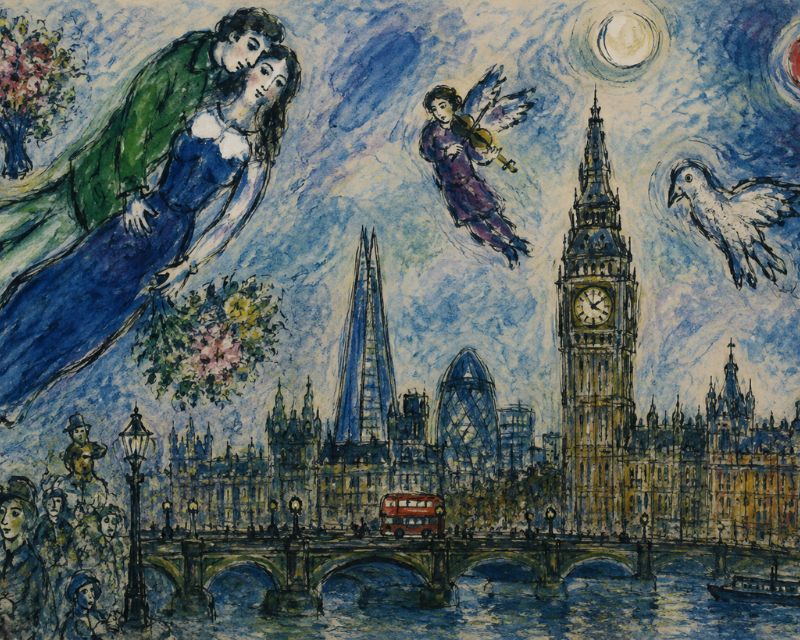
A picture in the style of Chagall
Whether held by private collectors, museums, charitable foundations or public institutions, great works of art are more than financial assets. They are lived with, studied, exhibited and preserved for future generations. Ownership is often viewed as stewardship rather than possession.
Some of the world’s greatest masterpieces have also delivered extraordinary long-term appreciation. Leonardo da Vinci’s Salvator Mundi sold for $450.3 million, Andy Warhol’s Shot Sage Blue Marilyn achieved $195 million, Pablo Picasso’s Women of Algiers (Version O) realised $179.4 million and Amedeo Modigliani’s Nu Couché reached $170.4 million. Yet advisers, art lawyers, dealers and collectors tell Citywealth these exceptional sales represent only a rarefied corner of a much broader international art market. For most buyers, long-term value depends less on chasing auction records than on provenance, authenticity, rarity, condition, legal certainty and careful stewardship.
More than an investment
Joshua S. Rubenstein, global chair of the private wealth department at Katten, New York believes art is unlike almost any other asset because it combines personal fulfilment with financial value while presenting unique planning challenges.
“Art continues to fill the dual role of a passion and an investment. As a passion, one gets the fulfilment of assembling and displaying works of art that are meaningful to the collector. From an income tax standpoint, there can be significant benefits to a true collector, who is generally someone who owns more art than he or she can display. From an estate tax standpoint, however, there are enormous challenges to keeping one’s collection intact, as it is hard to pay the estate taxes on one’s collection without selling it, unless you have arranged for the liquidity from other sources. That is why so many collectors keep their collections intact by giving them to museums, in which case there is no estate tax.”
He says the investment case remains compelling, but buyers should remember that the art market behaves very differently from public markets.
“As an investment, on the one hand, fine art can be expected to appreciate significantly over time. On the other hand, monetizing artwork is much more complicated and uncertain than selling shares of publicly traded securities, for which there is an enormous market. The market for art, and for certain types of art, is much thinner and can change over time as tastes change, and can also vary at any given moment depending upon how much similar art is being sold at the same time. Auction results can vastly outperform or underperform appraised value, depending upon what the demand happens to be at the time of the auction. Similar considerations are involved with private sales, and both auctions and private sales typically involve significantly larger sales commissions than publicly traded securities. In short, investing in art has rewards but also comes with risks.”
Collect with your head and your heart
Jacqueline Nowikovsky, founder of N Fine Art, believes the debate over whether art outperforms financial markets often misses the real purpose of collecting.
“Art should be viewed as a long-term passion asset rather than a purely financial investment. Depending on the methodology and time period, studies have shown that some artworks have outperformed the S&P 500, while others demonstrate that a simple investment in the stock market would have delivered better returns. That, however, misses the point of collecting. Tastes shift, generations change and markets evolve, but the most enduring collections are built around works that their owners genuinely love.”
Nowikovsky believes emotion should always be balanced with discipline and professional advice.
“An experienced advisor will undertake as much due diligence as possible to help ensure that what is acquired is also a store of value, considering provenance, condition, rarity, market depth and the artist’s long-term significance. For private clients, blue-chip works continue to offer relative resilience, while carefully selected contemporary artists can present compelling opportunities, but diversification, patience and disciplined acquisition remain far more important than chasing headline records. And as with every industry, anybody making fantastical promises of guaranteed outsized returns should be met with healthy scepticism.”
Art as a record of history
Art does more than appreciate in value. It records history.
The most enduring works are often inseparable from the lives of the artists who created them and the periods they represent. Marc Chagall’s paintings reflect exile, Jewish identity and the upheaval of twentieth-century Europe, while Francis Bacon’s work captures the psychological intensity of post-war Britain and London’s artistic and social transformation. Their appeal lies not simply in technical brilliance, but in their ability to embody the people, places and events that shaped modern history.
Collectors are therefore acquiring more than an object. They are becoming custodians of a work that carries artistic, historical and cultural significance. That enduring relevance helps explain why museum-quality works continue to attract collectors across generations and why many of the finest private collections ultimately find a permanent home in museums and public institutions.
Headline prices tell only part of the story
Charlotte Gir, solicitor at Seddons GSC, believes record-breaking auction prices should always be viewed in context.
“Auction prices that make headline news can signal to those seeking investment opportunities the potential financial appeal of artworks. However, these sales should be considered in the context of the wider auction market, as record-breaking transactions are not necessarily representative of the broader art market. While art can form part of an investment strategy, private clients often overlook the associated risks. These include the illiquid nature of the asset, significant transaction costs, insurance, storage and conservation expenses, as well as the critical importance of authenticity, provenance and condition in preserving long-term value. Resale opportunities can also be highly selective. While exceptional works by established artists with strong provenance may appreciate significantly over time, many others may take considerably longer to achieve comparable returns. Art is therefore often considered a valuable alternative asset, but it is best approached as a long-term holding within a considered wealth planning strategy rather than as a guaranteed route to short-term investment returns.”
The market behind the headlines
William Pearlstein, founder of Pearlstein & McCullough, believes buyers should distinguish between the trophy market and the wider art market.
“Fine art can and should be viewed as an investment asset, but potential buyers should be gimlet eyed when contemplating any purchase above $50,000. The stratospheric auction prices are largely limited to exceptional works from well-branded artists consigned by well-known collectors and their estates. Blue-chip, investment grade art is a safe bet for blue-chip investors. But the halo around an artist’s best work may not justify inflated asking prices for the artist’s lesser works.”
He believes the market changes significantly below the very highest level.
“The middle market is much trickier, and more geared to connoisseurs who collect more for love than money. The contemporary market is heavily influenced by a small group of art advisers who tend to see the same work at the same art fairs and galleries. This can create a herd mentality at the top.”
Pearlstein points to the contrast between blockbuster auction headlines and overlooked quality.
“As to the Salvator Mundi, the run-up to $450 million speaks more about the sheer amount of disposable income driving the market for trophy art than anything else. At the Lauder sale, Gustav Klimt’s Portrait of Elisabeth Lederer sold for over $236 million, while a superb Philip Pearlstein painting sold for around $130,000. That illustrates how unpredictable the market can be.”
He concludes:
“The art market has always been split between investors and connoisseurs. The trick for buyers is to be both at once.”
Beyond market performance, legal certainty is increasingly recognised as part of an artwork’s value. Ownership disputes, provenance questions and authenticity issues can all affect prices, even for museum-quality works.
Sarah Barker, partner and global co-head of our art law at law firm Withers, adds her thoughts. “They say that ‘real art people ‘will always shudder at the use of the word ‘investment’ in conjunction with art. Much is being made of the recent £306m sale of masterpieces from the Joe Lewis collection at Sotheby’s in June.” Lewis, assembled the collection with his daughter over four decades: he was a billionaire investor and former Tottenham Hotspur Football Club owner. “Though some point to it being evidence that Joe Lewis – a highly successful trader and investor – was also a brilliant speculator when it came to art, others highlight the fact that not all of the works sold made the same extraordinary returns as the 3,500% return reportedly generated on his Francis Bacon self-portrait which sold for £13.5m.”
“Tastes do change over time, but the very best works by a limited number of well-established artists are unlikely to be without demand from the small pool of potential buyers that have the means to acquire such museum-quality works. This is amply demonstrated by the Joe Lewis sale. Additionally, demand seems to be increasing from new demographic and geographical groups; it is reported that significant demand for the Joe Lewis sale came from Asian collectors bidding for those masterpieces of western art. Furthermore, over time blue-chip works will be in perhaps greater demand as museums around the world acquire more of them, thereby reducing the supply in private hands.”
“That said, even museum-quality works – where authenticity and attribution have been clearly established – can be at risk of issues leading to diminution of value. For example, buyers should always take expert legal advice to guard against the perils of title disputes which might arise due to fraud, inheritance and other family disputes, disagreements around collateralised art, theft, or claims for restitution or repatriation. In this context provenance is key, and it is increasingly the case that previous owners who are now considered undesirable, and/or the circumstances in which previous owners may have come to acquire an artwork, can negatively impact upon values. A recent case involving Christie’s in the English Courts includes a question around what provenance information a guarantor-buyer received in relation to a Picasso work whose value will now be dramatically diminished.”
For Clarissa Levi, art should also be viewed differently from traditional financial assets because returns depend on far more than market performance alone.
Levi who is art and heritage counsel at law firm Wedlake Bell said. “The danger is to look at a $100 million auction result and assume the entire market is rising. In reality, returns are concentrated among a relatively small number of exceptional artists and works. Art can preserve and create wealth, but it is not a passive investment. Provenance, authenticity, condition, liquidity and transaction costs all matter. The best collectors buy quality first and investment second.”
A legacy beyond financial returns
The contributors reach much the same conclusion. Art should not be viewed solely through the lens of investment performance. Unlike most assets, it combines financial value with emotion, scholarship, history and public benefit. Yet the recent Sotheby’s sale of masterpieces from the Joe Lewis Collection, which realised more than £306 million and included works by Francis Bacon, Lucian Freud, Gustav Klimt and Amedeo Modigliani, demonstrates that exceptional art can deliver remarkable financial returns as well as emotional and cultural significance.
The lesson, however, is not that every artwork is an investment. The Lewis Collection represented a carefully assembled group of museum-quality works by some of the twentieth century’s most celebrated artists. For most collectors, long-term success depends on knowledge, patience and careful due diligence. Provenance, authenticity, clear title, condition and expert advice remain just as important as artistic quality, while liquidity, ownership costs and succession planning should form part of any serious collecting strategy.
For collectors, advisers and the wider wealth industry, successful stewardship means balancing investment discipline with a responsibility to preserve works of lasting artistic and historical significance. The finest collections enrich the lives of those who own them and, in many cases, ultimately become part of museums and public institutions, ensuring they continue to educate and inspire long after today’s market headlines have faded.
Key takeaways
The strongest collections are built with knowledge, patience and passion, rather than by chasing headlines.
Art combines financial value with emotional attachment, historical significance and cultural legacy.
Record-breaking auction prices represent only a small part of the international art market.
Provenance, authenticity, rarity and condition remain the principal drivers of long-term value.
Great works derive value from their artistic merit, historical importance and cultural relevance.
Ownership costs, liquidity and succession planning should be considered alongside appreciation.
Art was discussed at the:
Citywealth Forum USA – New York 2026
Beyond the Frame: Managing and Transitioning Major Art Collections. When Collecting Outlasts the Collector
The art panel focused on a question that is becoming increasingly difficult to ignore within private wealth: what happens when collections outlast the individuals who built them. As lifespans extend and wealth transitions accelerate, responsibility for significant art holdings is expected to fall more frequently to spouses, daughters and female heirs, often without the same level of engagement in the original collecting process.
Moderated by Francesca Boschini of Deutsche Bank Wealth Management, the session was positioned to examine art not as a passive store of value, but as an asset class that brings financial, logistical and emotional complications, particularly at moments of transition.
A central line of thinking was to explore the gap between acquisition and stewardship. Collections are often built over decades with a clear personal vision, yet the burden of managing, maintaining or divesting those assets can fall to individuals who did not shape that vision and may not wish to continue it. This raises practical questions around custody, insurance, valuation and eventual sale, alongside more sensitive issues of legacy and family expectation.
Courtney Christensen, Senior Director, Trusts & Estates at Winston Art Group discussed the increasing importance of discipline in collection management. Regular valuations, rigorous record keeping and clear provenance are no longer optional but essential, particularly in the context of estate planning and potential disputes. As collections grow in value and complexity, the need for structured oversight begins to mirror that of more traditional financial assets.
From a market perspective, Sherri Cohen, Senior Vice President, Global Head of the Fiduciary Client Group at Sotheby’s cited a shifting landscape. The highest value segment, accounting for some of the largest values, raised questions around timing, liquidity and strategy, particularly for estates that may be required to sell within defined timeframes. Tax considerations, including the impact of capital gains versus step up in basis, were expected to sit alongside more practical decisions about where and when to bring works to market.
At the same time, the composition of demand is changing. New bidders, including younger collectors, are entering the market with different preferences, often extending beyond fine art into luxury categories such as jewellery, watches and design. This shift introduces both opportunity and risk, particularly for collections that may no longer align with current taste or market momentum.
Danielle Amato-Milligan offered a complementary perspective, focused on the intersection between private collections and the institutional world. For some families, philanthropy, donation or long term partnership with museums and foundations may form part of the solution. However, these routes introduce their own complexities, including governance, valuation and alignment between family intent and institutional priorities. Her work with both families and cultural organisations highlighted the importance of approaching these decisions holistically rather than as isolated transactions.
Across the panel, there was an underlying recognition that art behaves differently from other assets. Emotional attachment, often tied to the identity of the original collector, can sit uneasily alongside financial considerations. This tension is particularly evident in moments of succession, where decisions about sale, retention or division can create friction within families, especially where collections have not been evenly allocated or clearly addressed in estate planning.
There is also a growing awareness that the profile of the decision maker is changing. As women come to control a greater share of global wealth, including through inheritance, their influence on the direction of collections and the wider market is expected to increase. This shift is not only demographic but behavioural, with indications that female collectors may approach acquisition, risk and artist relationships differently.
Save the date
See the Citywealth Forum New York agenda for
10th March 2027 here
15:30 – 16:15 | Panel 3: The New Trophy Assets
Sports, Art & Alternative Investments in a Liquidity-Constrained World
The world’s wealthiest investors are increasingly allocating capital beyond traditional investment portfolios. Sports franchises, minority team ownership, art collections and other passion assets have become established components of family office wealth.
As institutional capital enters these markets, how should private investors assess opportunity, governance and liquidity?
Discussion Points
- The Boston Celtics transaction and sports franchise valuations
- Minority ownership rights and governance
- Sports as an institutional asset class
- Art as an investment versus a passion asset
- Secondary markets and liquidity
- Art lending and private credit
- Valuation challenges
- Family office allocation trends
- Insurance and risk management
- Private museums and legacy planning
Subscribe to the Citywealth Weekly Newsletter to learn more about Private Wealth Management.
Read more:
IFC insights: Indian wealth management
The Global Migration Shake-Up: Why the Wealthy Are Moving
Citywealth Leaders List: Top 30 Immigration Advisors 2026
Citywealth Forum 2026 – Speaker: Matthew Briggs, Boyes Turner
60 seconds with Matthew Briggs, Boyes Turner


Bermuda Update 2026: Trusts, Life Insurance and the Next Phase of Digital Assets
Bermuda's wealth and fintech sectors are evolving beyond traditional trust planning and cryptocurrency regulation. From trust flexibility and life insurance structures to artificial intelligence, digital identity and tokenisation, advisers say the next phase will be defined by how established financial institutions adopt and integrate emerging technologies.
Why Malta is becoming a magnet for family offices and internationally mobile wealth – Malta update 2026
From London advisers to Italian tax specialists, a growing number of wealth professionals are making the case for Malta. The question is: why now?