Citywealth Forum 2026 Speaker spotlight: Joshua Rubenstein, Katten
Joshua Rubenstein, Partner and Global Chair of Private Wealth at Katten, discussed the growing complexity of litigation, ageing and mental capacity during the litigation and capacity panel at the Citywealth Forum 2026, highlighting the rise in lifetime disputes, the legal realities of diminished capacity and the increasing importance of communication and documentation within wealthy families.
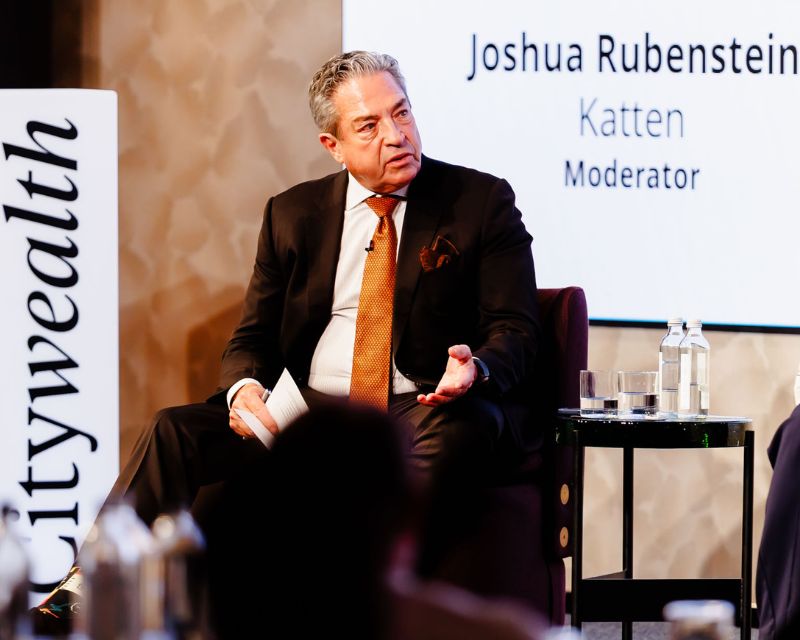
Joshua Rubenstein, Partner and Global Chair of Private Wealth at Katten, opened the litigation and capacity panel at the Citywealth Forum 2026 with a blunt observation about the changing dynamics of wealth disputes.
“People are living longer than ever… and rich people are living much longer than ever,” he said.
That increasing longevity, he argued, is reshaping the way disputes emerge within wealthy families. Wealth creators are living into periods where capacity may gradually diminish, while beneficiaries are waiting longer than ever for wealth transfers to occur.
“The deserving expectant beneficiaries are waiting longer than ever… and people are just not waiting anymore. They’re fighting.”
For Rubenstein, this shift is driving more disputes during lifetime rather than after death, fundamentally changing how advisers, families and courts deal with questions of capacity and influence.
Capacity is not one thing
One of Rubenstein’s central points was that “capacity” is often misunderstood as a single legal standard when, in reality, it varies significantly depending on the decision being made.
“There’s different definitions of capacity for different acts,” he said.
He outlined the distinction between wills, trusts, trusteeship and marriage, particularly from a US legal perspective. Testamentary capacity, he explained, is intentionally set at a relatively low threshold.
“If you know the nature and extent of your assets and the natural objects of your bounty, you have testamentary capacity.”
That means an individual may still be legally capable of making a will even while experiencing serious impairment in other areas of life.
By contrast, acting as a trustee or entering into complex trust arrangements can require significantly higher levels of understanding and judgement.
The implication, Rubenstein argued, is that capacity cannot be assessed in isolation. It is context specific and closely tied to the nature of the act itself.
The reality of diminishing capacity
Rubenstein also focused on the practical realities advisers increasingly encounter with ageing clients.
Many individuals, he noted, are neither fully incapable nor fully independent. Instead, they exist within a difficult grey area.
“A lot of them will be competent, but having a hard time making decisions.”
That ambiguity is often where disputes emerge, particularly when family members or advisers begin influencing outcomes.
Influence versus undue influence
A key distinction throughout Rubenstein’s remarks was the difference between ordinary influence and legally actionable undue influence.
“Lots of people try to influence lots of people all the time. The test is not influence, it’s undue influence.”
Families naturally attempt to persuade one another, he explained, and persuasion alone is not unlawful. The legal concern arises when somebody exploits diminished capacity or abuses a position of trust.
“Undue influence is when you’re taking advantage of someone when he can’t protect himself.”
He also noted that courts view different relationships differently. Spouses, for example, are often permitted greater influence before concerns arise because of the closeness and dependency inherent in those relationships.
The risks of lifetime disputes
One of the strongest themes running through Rubenstein’s contribution was the increasing number of disputes taking place while the wealth creator is still alive.
“People are no longer waiting for death… they want to step in now.”
While intervention may sometimes be necessary, particularly in cases involving abuse or financial mismanagement, Rubenstein warned that lifetime contests carry considerable risks.
“There is so much potential for downside to doing a lifetime contest.”
Those risks can include:
- damaging family relationships
- triggering retaliation from the wealth creator
- facing a significantly higher burden of proof
“If you try to contest during their lifetime, the contestant has the burden of no capacity,” he said.
After death, by contrast, the burden often shifts towards those defending the will or structure. That distinction, he suggested, is frequently underestimated by families entering litigation.
The problem of retaliation
Rubenstein was particularly direct about the risks of unsuccessful intervention.
“If you’re gonna shoot the king, you better kill him,” he said.
The point, while stark, reflected a practical reality. A failed challenge can provide the individual involved with a clear roadmap for excluding or disinheriting family members who initiated the dispute.
“You have now given him a roadmap for disinheriting you.”
That risk, Rubenstein suggested, explains why many families hesitate before acting even where concerns about capacity or influence already exist.
Documentation over reaction
Given those risks, Rubenstein repeatedly returned to the importance of preparation and documentation rather than immediate confrontation.
“Our advice to clients is usually just keep incredibly careful notes and records.”
That can include documenting:
- conversations
- behavioural changes
- unusual transactions
- asset transfers
- incidents that may later become relevant to undue influence claims
“Money is retrievable,” he said, suggesting that financial harm can often be addressed later if sufficient records exist.
Healthcare decisions, however, were different.
“If it’s healthcare related, you have no option… you do the right thing because you love your dad.”
Managing expectations and avoiding disputes
Rubenstein also argued that many inheritance disputes ultimately stem from poor communication.
“Most contests come because it’s a surprise.”
Where decisions are explained clearly during lifetime, even difficult or unequal decisions are less likely to trigger litigation later.
“You have to say, ‘I’m not treating you the same… here’s the reasons.’”
Without that transparency, he suggested, families often redirect frustration towards one another rather than towards the underlying decisions themselves.
“Be mad at the right person,” he said.
For advisers, that means encouraging difficult conversations early rather than relying solely on legal structures to avoid conflict.
A practical rather than theoretical approach
Rubenstein’s contribution stood out because of its realism. Rather than focusing solely on technical legal distinctions, he concentrated on how these disputes actually emerge within families.
Capacity disputes, in his view, are rarely purely legal issues. They are shaped by timing, family relationships, expectations and increasingly by longevity itself.
His message throughout the session was clear. As people live longer, the period during which capacity may become contested is widening and with it, the likelihood of conflict.
For advisers and families alike, that means placing greater emphasis on communication, preparation and documentation before disputes escalate.
Key quotes from Joshua Rubenstein
“People are living longer than ever… and rich people are living much longer than ever.”
“The deserving expectant beneficiaries are waiting longer than ever… and people are just not waiting anymore. They’re fighting.”
“There’s different definitions of capacity for different acts.”
“If you know the nature and extent of your assets… you have testamentary capacity.”
“The test is not influence, it’s undue influence.”
“There is so much potential for downside to doing a lifetime contest.”
“Most contests come because it’s a surprise.” “Our advice is to keep incredibly careful notes and records.”
Subscribe to the Citywealth Weekly Newsletter to learn more about Private Wealth Management.


Citywealth Forum USA – March 10th 2027 proposed date
Call for speakers, patrons, and financial partners. Shape our content for the Citywealth Forum USA 2027
Citywealth Forum USA 2026 speaker spotlight: Emily Dreas, Managing Director and Senior Market Executive, Bank of America Private Bank
The Billion-Dollar Game: Women’s Sport, Celebrity Capital & the Future of Investment