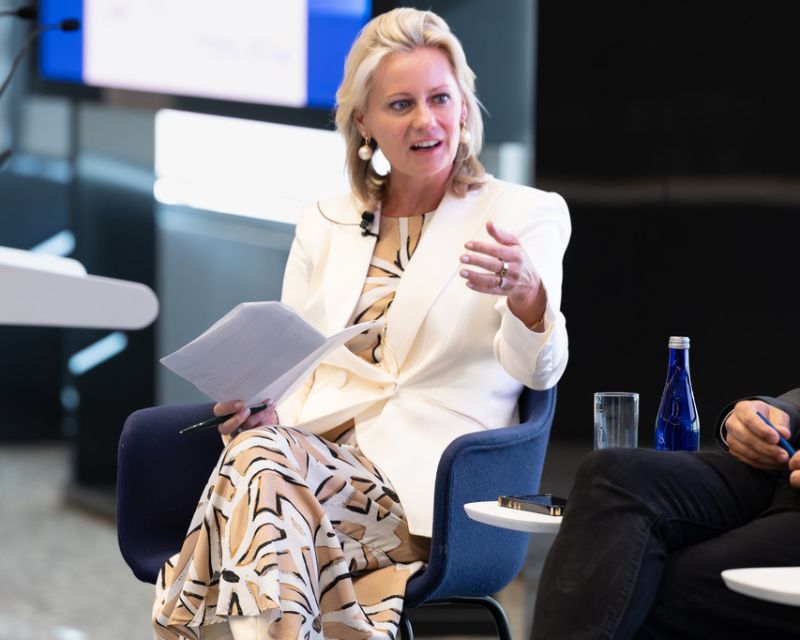
Citywealth Forum USA 2026 speaker spotlight: Emily Dreas, Managing Director and Senior Market Executive, Bank of America Private Bank
The Billion-Dollar Game: Women’s Sport, Celebrity Capital & the Future of Investment
Overview
Emily Dreas opened and moderated the discussion by placing women’s sport within a broader shift in client behaviour. Her remarks focused on demand, capital flows, and how ultra high net worth investors are approaching sports ownership as part of a wider portfolio strategy.
She framed the conversation around a simple point. A few years ago, women’s sport would not have featured in this context. Now it is being actively considered by clients alongside more established asset classes.
Key Themes from Emily Dreas
1. A Shift in Investor Demand
Dreas made clear that interest in sports ownership has moved quickly. Where it was once unusual, it is now common for clients experiencing a major liquidity event to consider investing in a team.
She noted that this is no longer limited to men’s leagues. Women’s sport is increasingly part of that conversation, reflecting both its growth and its perceived long term potential.
2. Women’s Sport Reaching a Turning Point
She described the current moment as a tipping point. Growth in audience numbers, media coverage and commercial backing has brought the sector to a stage where it can no longer be viewed as early or speculative in the same way.
At the same time, she stressed that revenue remains critical. Investment decisions still depend on the ability of an asset to generate returns, supported by fan engagement, sponsorship and media rights. She also pointed out that men’s sport historically benefited from owners and backers with significant capital who were willing to invest over long periods. In her view, women’s sport now requires similar long term support from investors with deep pockets if it is to reach the same level of scale and stability.
3. Deep Client Exposure to the Sector
Dreas highlighted the extent of her firm’s involvement. A significant proportion of principal owners of US based teams are clients, giving the bank direct exposure to how ownership structures and investment strategies are evolving.
This level of engagement means that insights are drawn not only from theory, but from active participation in transactions, financing and long term planning.
4. Ownership Is Becoming More Accessible
A key shift identified by Dreas was the move away from single owner models. Instead, ownership is increasingly structured around groups of investors, often taking minority stakes.
This has opened the market to a wider pool of ultra high net worth individuals who may not seek control, but want exposure to the asset class.
5. Sport as Part of a Broader Portfolio
Dreas positioned sports ownership as part of a diversified investment strategy. While historically seen as a trophy asset, it is now being assessed alongside other long term investments.
Clients are looking not only at potential returns, but also at access, influence and alignment with personal interests.
6. The Role of Sport in Leadership and Identity
She also touched on the wider role of sport, noting its connection to leadership development. Drawing on internal research, she pointed out that a high proportion of senior executives have participated in sport at some level.
This link between sport, leadership and personal identity helps explain why clients are drawn to the sector beyond purely financial considerations.
Closing Perspective
Dreas framed women’s sport as part of a broader evolution in how clients invest and what they value.
Her emphasis was on demand and direction of travel. Capital is already moving into the space, and client interest is established. The question is no longer whether women’s sport will attract investment, but how quickly and at what scale.
Key Points from the Discussion
- Client demand for sports ownership has increased significantly in recent years
- Women’s sport is now part of mainstream investment conversations
- Revenue generation remains central to investment decisions
- Long term backing from well capitalised investors will be critical to future growth
- Ownership structures are shifting towards minority stakes and investor groups
- Sport is increasingly viewed as part of a diversified portfolio
Fellow Panelists
- Arya S. Rahimian, Managing Director, Valuation Advisory Services, Kroll
- Jess Alden, Partner, Slateford
- Lisa Barksdale, Head of Global Wealth & Investment Management Credit, Bank of America
For more information, click here.
Subscribe to the Citywealth Weekly Newsletter to learn more about Private Wealth Management.


Citywealth Forum USA 2026 speaker spotlight: Francesca Boschini, Director and Head of International Wealth Planning and Head of Insurance Solutions for the Americas, Deutsche Bank Wealth Management
Beyond the Frame: Managing and Transitioning Major Art Collections
Citywealth Forum USA 2026 speaker spotlight: Sherri Cohen, Senior Vice President and Global Head of the Fiduciary Client Group, Sotheby’s
Beyond the Frame: Managing and Transitioning Major Art Collections