Top Ten Sustainability Trends in Wealth Management (2025 Update)
By Emilie Shaw, Sustainable Solutions Lead at Cazenove Capital.

Key sustainability trends reshaping private wealth
The wealth management industry is being reshaped by major sustainability trends in 2025. From sustainable investing and impact strategies to climate action and philanthropy, private wealth advisors and UHNW families are embracing new ways to balance growth with responsibility. This feature explores the ten most important sustainability trends in wealth management today.
How would you describe the current state of sustainable investing in private wealth?
In terms of top ten trends in sustainability and ESG and how it is evolving from values-based to performance-driven. In 2020-2021, we experienced an “ESG boom,” driven by a pandemic that highlighted systemic fragilities and a concerted effort to “build back better.” Asset managers rushed to join public initiatives to show their commitment. Many companies also bolstered their DEI efforts following the murder of George Floyd and the subsequent Black Lives Matter movement. Companies talked more about “stakeholders” than “shareholders”.
Over time, priorities began to shift, particularly following the invasion of Ukraine. Immediate energy security took precedence over the long-term energy transition. At the same time, anti-greenwashing regulations began to expose some of the gap between marketing claims and what firms were actually doing, leading to a more cautious stance.
Implications for UHNW families & family offices
The earlier wave of ESG excitement may have receded. However, many active investors remain focused on identifying and understanding ESG factors that are material to investment returns. Encouragingly, there is less focus on words and more on what companies do.
It also remains the case that many of our clients want to see their values reflected in their investments. For them, opting for a portfolio which avoids harm and contributes to solutions remains a priority. We have seen a continued momentum in the adoption of sustainable mandates, with assets in our sustainable, impact or ethically screened solutions rising to over £11bn (as at 31st December 2024), a 375% increase in 6 years.
Cazenove Capital client assets invested in sustainable, impact or ethically screened mandates
As of 31 December 2024, across UK and Channel Islands
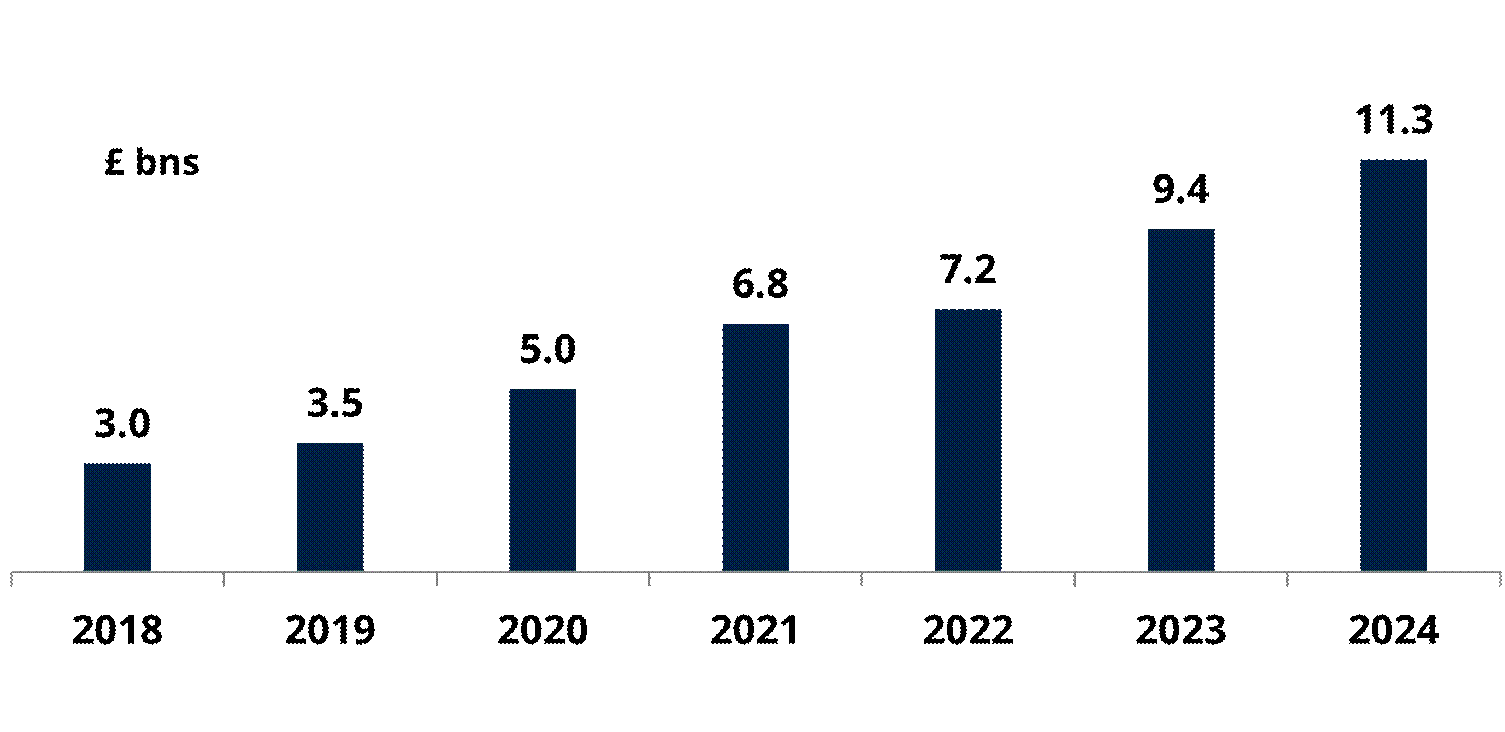
Source: Cazenove Capital as of 31 December 2024.
See more here: What does Trump’s anti-ESG campaign mean for sustainable investment?
How have recent regulatory or political developments (e.g. SFDR, SEC guidelines, green taxonomy) impacted ESG allocations and reporting standards?
Recent regulatory and political developments have increased transparency, standardisation, and accountability across the industry. These shifts have translated into both challenges and opportunities.
For example, the EU’s Sustainable Finance Disclosure Regulation (SFDR) has compelled asset managers to be much more rigorous and explicit in how they classify and report on ESG products. It’s not enough to market a fund as “sustainable” — we now need to substantiate it with clear, quantifiable data and disclosures. This has driven a reallocation within ESG-labelled strategies, with some products being downgraded (e.g., from Article 9 to Article 8) as managers reassess whether they meet the stricter thresholds. Similarly, the UK Sustainability Disclosure Requirements (SDR) resulted in a wave of funds removing sustainability terms from their fund names as they struggled to adhere to the stringent requirements. We have prioritised aligning to industry best practise and were thrilled to have adopted the SDR ‘Sustainability Focus’ label for our flagship sustainable funds, the SUTL Cazenove Sustainable Growth Fund, SUTL Cazenove Sustainable Balanced Fund and SUTL Cazenove Charity Sustainable Multi-Asset Fund. To our knowledge, we are the only wealth manager with a multi-asset and multi-manager approach to adopt the label.
What to watch next in sustainable investing
The EU Green Taxonomy is pushing the market toward a more science-based framework. It’s helping to define what economic activities are genuinely environmentally sustainable, which in turn influences capital allocation. While implementation is still evolving, the taxonomy is guiding portfolio construction and product development, particularly in thematic funds aligned with climate or biodiversity goals.
Overall, these developments are helping to filter out greenwashing and are prompting a deeper focus on materiality, impact, and stewardship. While this has raised the bar for compliance and reporting, it also strengthens the integrity and credibility of sustainable investing, which is ultimately beneficial for investors and the planet alike.
- What ESG themes — such as biodiversity, energy transition, water security, or social equity — are capturing the most interest from private clients?
Results from our 2024 client sustainability poll showed climate/ energy transition to be the main concern of asset owners, while biodiversity impacts and risks are increasingly raised.
Are wealth managers seeing increased demand for impact-focused strategies that go beyond ESG screening — and how are they delivering them?
Yes. We are seeing growing demand for impact-focused investments. There has been sustained momentum in the adoption of sustainable mandates, with assets in our sustainable, impact, or ethically screened solutions rising to over £11bn as of 31 December 2024 — a 375% increase over the past six years.
As sustainability continues to rise on the political and social agenda, clients who are passionate about promoting a cleaner and fairer world are increasingly looking to go beyond traditional ESG screening and allocate to impact-focused strategies.
To meet this demand, we have launched a listed impact model portfolio that prioritises investments in companies addressing environmental and social challenges, aligned with one or more of the UN Sustainable Development Goals — such as renewable energy generation and microfinance.
We are also helping clients allocate to private market investments, where there is greater potential to maximise the intensity of their capital’s impact. By providing funding to early-stage solution providers, clients can support the scaling of innovations that directly contribute to climate and social goals.
How are family offices and trustees approaching sustainability within broader fiduciary and legacy planning conversations?
We have observed an increased interest in sustainable private assets – mostly aiming for at least market rate returns.
What tools or metrics are most useful when assessing ESG risk and return, and are clients asking for more granular data?
We view the consideration of sustainability is part of our fiduciary responsibilities, and that it may contribute towards the delivery of long-term returns. The decarbonisation of the global economy presents various risks and opportunities.
Transition risks
Transition risks stem from the necessary changes in the economy to limit long-term temperature rises. These include shifts in demand for goods and services, and changes in costs for companies, sectors or asset classes. Such risks may arise from new or enhanced corporate climate change laws and regulations, changes in demand for climate-focused products, and greater volatility in financial markets as asset prices adjust to reflect the increasing regulation of GHG emissions.
Physical risks
Physical risks refer to the threats posed by long-term changes in climate, leading to more extreme weather events that may affect future business activities and the value of investments, and the risks to our business and property assets, as well as those of our suppliers and partners.
The approach to identifying, assessing and managing climate risks and opportunities differs depending on the asset class: – for listed assets, where a growing volume of data is available to assess companies, models support our investment teams in identifying climate-related risks and opportunities, augmenting their own company and industry insights. Where third party funds are held, we assess third-party managers on their alignment to the Paris Agreement and the extent to which they consider climate-related risks and opportunities in their investments.
Proprietary tools
SustainEx™ uses academic studies to scientifically estimate the measures of both harm companies can do and the good they can bring to arrive at an aggregate measure of each firm’s social and environmental outcomes.
Climate tools – we also have a suite of climate tools, recognising that this complex challenge is multi-faceted and we need multiple lenses to build an understanding of climate risk across our investments. The tools include our Net Zero Dashboard which enables our investment teams and central risk function to monitor the temperature alignment of portfolios. It is an important component of meeting our net zero targets, which have now been formally verified by the Science Based Targets Initiative (SBTi).
We have recently developed the ability to show clients a forward-looking emissions pathway. The projection is created by taking the most ambitious target available for each company and projecting that on a linear pathway to its target end year.
Are there sectors or asset classes (e.g. green infrastructure, climate tech, sustainable private credit) that stand out as growth areas in 2025?
Yes, sustainable private assets stand out as a key growth area in 2025. Clients are increasingly turning to private markets not only to meet return expectations but also to advance their impact goals.
We believe that carefully selected sustainable private asset managers can enhance the risk, return, and impact profile of portfolios. Private markets offer a broader investment universe and access to opportunities not available in public markets — especially in emerging sectors like climate tech and green infrastructure.
Crucially, sustainable private assets allow investors to allocate capital directly to innovative companies addressing critical environmental and social challenges, helping accelerate progress toward sustainable development goals. This makes them highly aligned with investors’ long-term sustainability ambitions and policy frameworks.
How are private clients balancing concerns about greenwashing with the desire to align investments with values?
Growing regulatory scrutiny has helped reduce greenwashing by requiring fund managers to clearly define and evidence what they mean by terms like “sustainable” or “green.”
While the delay in applying the UK’s SDR rules to managed portfolios has created a gap in requirements of best practice between fund managers and wealth managers, clients are increasingly expecting the same level of transparency and accountability from their wealth managers as they now see from fund providers.
This shift is encouraging wealth managers to improve disclosure, clarify sustainability approaches, and provide stronger evidence that portfolios are genuinely aligned with clients’ values — not just marketed as such.
In what ways are you seeing generational shifts influence sustainable investment decisions within families or multigenerational wealth structures?
Generational shifts are driving a clear change in sustainable investing priorities. 3 in 5 younger family members expect more support from managers in developing creative solutions to address environmental and sustainability challenges, and 80% of the families with average assets of $1.1bn believe impact investing can prepare generations for greater responsibility. This reflects a growing desire among younger generations to align their wealth with their values.[1]
At the same time, there’s a service gap. Only 6% of Ultra High Net Worth clients are very satisfied with their adviser’s impact investing services, suggesting advisers must do more to meet rising expectations around values-led investing.[2]
With $30trn of wealth due to transfer to younger generations, these preferences will increasingly shape investment strategies. We’re working with families to ensure their portfolios reflect a shared vision across generations — combining purpose, performance, and long-term impact.
[1] Global Data’s report – “Intergenerational Wealth Transfer: Seizing the HNW Opportunity.
[2] Campden Wealth; Investing for Global Impact: A Power for Good report.
The ASIAN Family Office – Driving Impact and Innovation. Centre for Economic and Business Research,. WealthiHer Network study.
Subscribe to the Citywealth Weekly Newsletter to learn more about Private Wealth Management.
You might also like to review the Citywealth Forum
Read about litigation trends
Find more sustainability insights in our Top 15 Sustainability Experts 2025 list.

Oxford Innovation Finance invests in cutting-edge sensor technology to optimise crop growth
Oxford Innovation Finance’s EIS Growth Fund and OION Angel Network have invested in Gardin, the first real-time, remote and autonomous crop phenotyping SaaS platform, alongside LDV Capital, MMC, Navus Ventures and other investors.
Global trade in fake goods reached USD 467 billion, posing risks to consumer safety and compromising intellectual property
The global trade in counterfeit goods remains a major threat to economies, consumers and supply chains worldwide, according to a new OECD–EUIPO report.