Jean Prouvé: Carnac Demountable House
Galerie Patrick Seguin is pleased to present Jean Prouvé: Carnac Demountable House, a new publication bringing together a wide selection of archival documents and period photographs dedicated to the Carnac Demountable House with a preface by Catherine Prouvé.
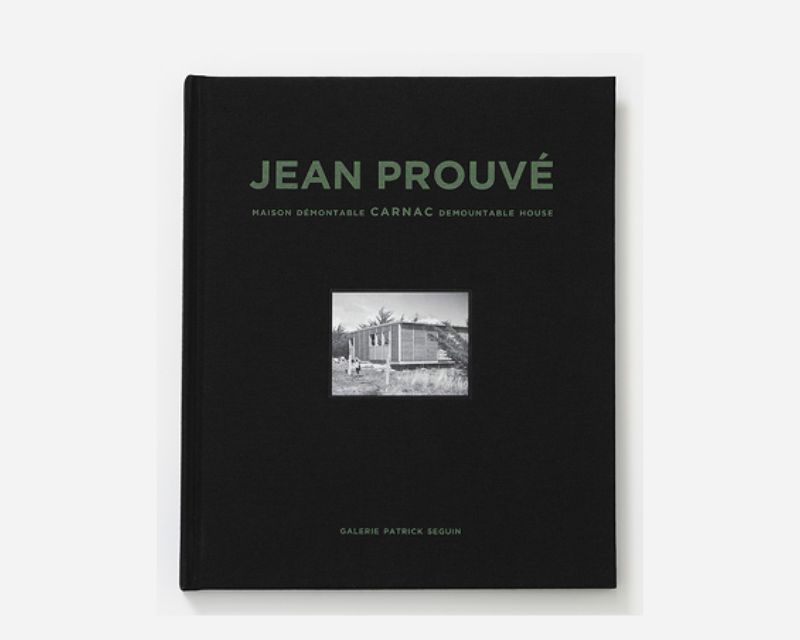
In the summer of 1946, shortly after the end of World War II, Jean and Madeleine Prouvé set up an 8×8 Demountable House in Carnac, Brittany, intended both as a holiday home for their large family and as a demonstration model for prefabricated housing. Shipped in several parts by train, the pavilion was based on Prouvé’s axial portal frame system, patented in 1939, combining lightweight metal components with standardized wooden elements assembled on site. Featuring steel-clad façade panels and windows, the house became one of the first and most significant postwar examples of Jean Prouvé’s vision for lightweight, industrialized and adaptable architecture.
This new publication brings together a wide selection of archival documents and period photographs dedicated to the Carnac Demountable House. Through this volume, the 16th in the series, Galerie Patrick Seguin continues its research and documentation work on Jean Prouvé’s demountable architecture, its historical significance, and its contemporary relevance.
Jean Prouvé (1901-1984)
Jean Prouvé was born in Paris in 1901. He opened his first workshop in Nancy in 1924, where he began producing furniture that was met with immediate success. Of the opinion that “in their construction there is no difference between a piece of furniture and a house”, he developed a “constructional philosophy” based on functionality and rational fabrication. Free of all artifice, the resulting aesthetic chimed with the doctrine of the Union of Modern Artists, of which Prouvé –along with Le Corbusier, Pierre Jeanneret and Charlotte Perriand– was a founder member. The same principles were applied to the creation of furniture –often intended for the public sector– and architecture, which experienced significant growth after World War II.
Prouvé is particularly renowned for his innovative applications of new materials, such as bent sheet steel and aluminum, as well as his pursuit of functional rationalization. These innovations allowed both furniture and buildings to be easily dismantled, transported, and adapted. Working with some of the greatest architects, he left his stamp on many famous examples of 20th-century building, most of which are now classified historic monuments. Jean Prouvé died in Nancy in 1984.
Subscribe to the Citywealth Weekly Newsletter to learn more about Private Wealth Management.
Read more:
Insurance Can Be Used to Complement a Trust Strategy | Citywealth News
Digital Assets and PPLI Explained | Citywealth News
Private Placement Life Insurance | Citywealth News


The Hari Singapore to Open in 2027
Harilela Hotels has set its sights on Singapore as the third home for its acclaimed hotel brand The Hari, complementing the existing properties in London and Hong Kong.
Wimbledon Screen Returns to St Katharine Docks Bigger, Better, and Ready to Ace Wimbledon 2026
St. Katharine Docks returns with an upgraded outdoor screen for the Championships – now on Marble Quay with room for everyone!