The Return of Wild Dogs: A Tsavo Triumph
At first glance, they look like a mirage against the red Tsavo road, one wild dog becomes two, then three, then ten, and before long, more than 20 have emerged from the thick bush and melted into my line of vision.
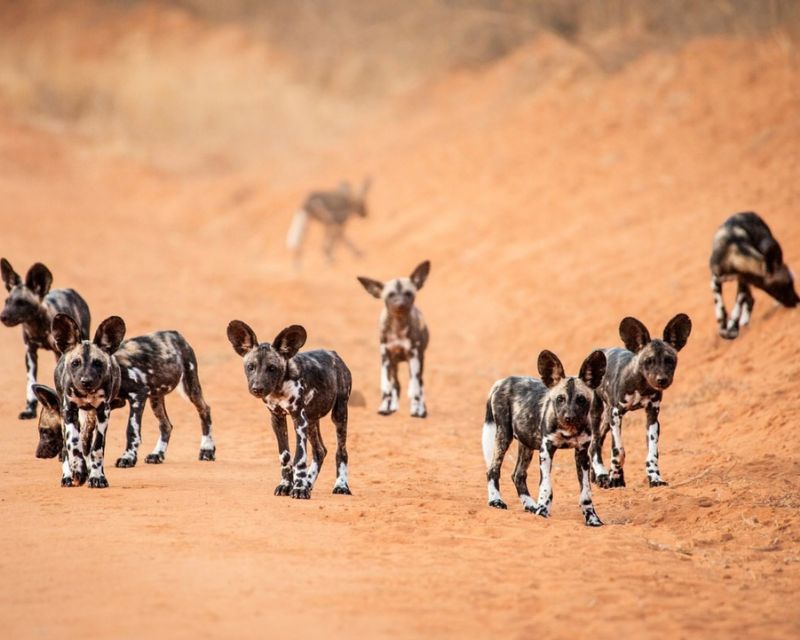
Once they’ve fully sussed out a situation and established that we come in peace, they relax. The pups gambol about with a series of chirps while the adults enjoy a few minutes of rest. We have been invited into the most sacred of wild encounters — animals well and truly at peace.
Not so long ago, this would have been an impossible sight in Ithumba, Tsavo’s northern area — not because the dogs were elusive, but because they had all but vanished from the landscape. This extinction was not unique to Tsavo or even Kenya: in recent decades, wild dog populations have disappeared from 25 of the 39 countries in which they were previously found. Today, fewer than 7,000 remain in all of Africa.
Wild dogs are highly vulnerable to human influence. Habitat loss and fragmentation have chipped away at their historical hunting grounds. Now, many surviving populations are forced to weave an uneasy existence on the periphery of farms and settlements, constantly flirting with the risk of human-wildlife conflict. This increasingly puts them into contact with domestic dogs and the diseases they may carry — entire packs are vulnerable to localised extinction from mange or distemper epidemics.
And of course, there is the scourge of poaching. Left unchecked, bushmeat poachers can extirpate prey species from a landscape. This tips the entire ecosystem out of balance, dwindling food resources for predators like wild dogs. Snares aren’t set to catch wild dogs, but they are terribly effective at killing them. Invisibly set at prey height, they are just as likely to noose their pursuer. Like so many other creatures, wild dogs are collateral damage in the vicious bushmeat trade.
Formidable Hunters and Family Animals
Wild dogs are incredibly efficient and precise hunters. Unlike Africa’s apex predators, they have an unusually high success rate, with about 80 percent of their chases ending in a kill. Lions have brute strength, leopards have stealth, and cheetahs have speed, but wild dogs have the power of the pack. They hunt in a highly coordinated endurance relay: leading dogs tag in and out, giving relief to those at the front without ever letting up the chase. Their white-tipped tails serve as flags, allowing the members of the pack to easily track each other.
While wild dogs hunt everything from warthogs to wildebeest, their preferred prey are medium-sized antelope. However, they have a remarkable capacity to kill: I’ve known them take down a full-sized eland weighing about 500 kilograms, leaving little more than bones behind — no small feat for a pack of animals weighing a lean 30 kilograms or so. Their coats come in a tawny melange of browns, blacks, reds, and white. Tails are always tipped in white, while muzzles are black. Each individual coat pattern is completely distinct, but collectively, their colours allow them to blend as one with the bush. To their prey, the pack in pursuit must be a chilling sight indeed — as though the landscape has sprung to life in an amorphous force, snapping at their heels.
Fearsome predators they may be, but wild dogs are also uniquely family-oriented. Their social structure revolves around the welfare of the pack, rather than the individual. The healthiest members work collaboratively to support the young, the aged, the ill, and the injured. Each pack is led by a dominant, monogamous pair. Unlike most animal social structures, males remain with their birth pack, while females leave the pack when they reach maturity.
The alpha female gives birth in a den — often a burrow repurposed from a warthog or other creature — and then spends several weeks nursing and nurturing her newborns. The rest of the pack delivers food into the den, takes on babysitting duties, or stands sentry outside. Once pups are old enough to venture into the wider world, they are communally and lovingly raised to adulthood by the pack. All being well, they can live upwards of 10 years. Unfortunately, due to the litany of threats they face, it’s increasingly rare for a dog to live out its natural lifespan. Instead, they are far more likely to fall prey to snares, disease, or human-wildlife conflict. The hunters have become the hunted.
Rehabilitating Tsavo’s Northern Area
Today, Ithumba is a jewel of the Tsavo ecosystem — but 25 years ago, when we first established operations there, it was a very different place. Like many parts of the country back then, it had been pummelled by decades of poaching and illegal activities. Elephants had essentially vacated the northern area — those who hadn’t been poached had retreated to safer ground — and they weren’t the only ones. Prey species had been largely hunted out of existence, leaving predators without adequate sustenance. All wildlife populations were in a precarious state.
Working in partnership with the Kenya Wildlife Service, we implemented extensive anti-poaching operations in Ithumba, installing permanent teams in the landscape and conducting daily patrols. Our SWT/KWS Ithumba Team, deployed in 2002, has emerged as a model for our anti-poaching operations across the country. Six teams are currently based in the northern area.
The northern area is Tsavo’s outback. It’s vast, wild, and difficult to contend with. While we established a comprehensive presence on the ground, we also placed special emphasis on aerial activities. Our pilots started flying daily patrols, coming to grips with this great landscape and understanding where its vulnerabilities lie. They extended anti-poaching operations by dropping teams into remote areas inaccessible by foot or vehicle, responded to wildlife emergencies and security incidents in rapid time, and ensured that no area went uncovered. The transformation of the northern area didn’t happen overnight, but it did happen more quickly than we ever dared hope. By removing snares and reducing threats across the ecosystem, we helped create an environment where Tsavo’s fragile, fragmented creatures could rebound.
Wild dogs were one of the most dramatic examples of recovery. The resident pack, which had been whittled down to near extinction in the area, began a tentative comeback. One of our first actions was to address the mange running rampant through their ranks. An insidious disease that is often carried over from domestic dogs, mange starts with hair loss and ends with enervation, emaciation, and ultimately death. Working with our SWT/KWS Tsavo Mobile Vet Unit, we placed a carcass, which had been injected with systemic antiparasitic drugs, in their area. Too weak to hunt and unable to resist a meal delivered into their midst, the dogs ate every last bite — and before long, mange had been fully eradicated from the pack.
As mortality rates decreased, the number of sightings increased. In fact, their resurgence was so successful that the initial surviving pack flourished into several splinter groups. Today, multiple wild dog packs call the northern area home, the largest with 40 members.
I cannot underscore enough how extraordinary this change is. Twenty-five years ago, it was astonishing to see a single dog. Now, they’re everywhere — if you only know where to look. Any pilot patrolling Tsavo’s northern area knows that they’ll be tracked by a dogged force on the ground — wild dogs are wonderfully inquisitive and know the sound of our aircraft flying overhead. When the dogs hear them, they often run in tandem on the ground, hounding their protectors in the sky. Wild dogs have ended up being one of the greatest measures of our success in Ithumba over the past 25 years. Improving security, removing snares, and banishing poachers had reverberations that are felt throughout the area. The creatures that had been poached to oblivion started to rebound. With prey numbers restored to a healthy level, predators finally had enough food to sustain themselves. And so the landscape began to recover, repairing broken links in a food chain that makes any ecosystem function.
The Next Chapter
Wild dogs are savvy, intelligent creatures. They’re doing their best to navigate a challenging world, from ebbing prey numbers to fragmented habitats to overt human threats. The Ithumba population’s recovery is a hopeful example of a path forward.
A key tenet of conservation is continued oversight. One doesn’t architect the rehabilitation of a landscape, then leave it to its own devices. Today, impact is only realised through a long-term commitment to a habitat. Profound knowledge of and experience in a place — which can only be established from decades embedded there — allow us to stay one step ahead of evolving threats, monitor wildlife populations, and, when needed, intervene directly. Over the years, we have come to the rescue of wild dogs many times. Just a few months ago, we had a visceral example of this. During a ground patrol, our SWT/KWS rangers reported that a member of the larger Ithumba pack had a wire snare cutting deeply into her waist. We attempted to treat her that same afternoon, but the dogs were already on the move, making it impossible to dart her.
For the next three weeks, our teams combed the vast northern area from the ground and air. We closely surveilled their den, looking for the injured dog, but she had seemingly disappeared. With home ranges spanning hundreds of square kilometres, wild dogs are constantly on the move, perfectly camouflaged, and thus very difficult to track down.
Finally, during an aerial patrol, Roan spotted her among a group of hunters returning to their den. At first, he thought his eyes were deceiving him: her injury had got even worse in the intervening weeks, but still the dog persevered in the hunt to support her pack.
We immediately mobilised the SWT/KWS Tsavo Mobile Vet Unit, while Taru flew the helicopter to shepherd the entire pack towards a more accessible area. Keeping them together was important; it’s much easier to monitor wild dogs en masse than to attempt to track a single animal in the thick bush. Once the patient was in a suitable location, the team was able to approach her on foot, dart her, and commence treatment. They removed the snare — which encircled her entire waist — treated the wounds, and carried her to a shady area, where she was revived. It wasn’t long before she was back on her feet and reunited with her pack, who were waiting nearby. In the weeks and months since, we have seen the pack at rest, at play, and at work — restored to full force, without a snare in sight.
Today, it’s hard to picture an Ithumba without wild dogs — they have become such a present part of the landscape. This dry season, the largest pack has essentially taken up residence down by Ithumba Camp, lolling on the sun-dappled red earth with great authority. They have also become fixtures at our Ithumba orphan herd’s haunts, often choosing the busiest times to stroll by the mud bath or waterhole. In fact, the dogs are so inured to the young elephants’ antics that they barely bat an eye when their appearance is met with a peacocking chorus of trumpets and mock-charges. Wild dogs are the face of a changing Africa, but also living, breathing testaments to what is possible when effective conservation supports a landscape and its denizens. I feel sure this is just the beginning of Tsavo’s wild dog renaissance — one that may have ripple effects across East Africa, given how connected their populations are proving to be.
Key Takeaways
- Wild dog populations drastically declined due to poaching, habitat loss, and disease, with fewer than 7,000 remaining in Africa today.
- Ithumba’s wildlife recovery began 25 years ago, thanks to anti-poaching efforts and habitat rehabilitation, leading to the return of wild dogs.
- Wild dogs are unique predators, displaying high hunting success rates and strong family bonds within their packs.
- Conservation efforts have enabled wild dog populations in Ithumba to thrive, with multiple packs now inhabiting the area.
- The return of wild dogs symbolizes successful conservation, demonstrating the potential for wildlife recovery in East Africa.
Karen Jones is the founder of Citywealth and a wealth management commentator with more than 20 years’ experience across global private wealth, family offices and succession. Before founding Citywealth in 2005, she held publishing roles at The Times and The Sunday Times, London; Legal Business magazine; and worked on the Asia Pacific Legal 500.
Subscribe to the Citywealth Weekly Newsletter to learn more about Private Wealth Management.
Read more:
Middle East: Top 30 Wealth Managers of 2025 – Citywealth
Harlequins Announce Exclusive Wealth Management Partnership with Titan Wealth
Titan Wealth acquires Ravenscroft investment management business in the UK
Titan Wealth acquires Ravenscroft Investments Limited


The People’s Mosquito Project Awarded Over £100k By The Lottery Heritage Fund
Six-figure grant for charity aiming to return famous WW2 Mosquito aircraft to the skies
Dormant Assets Scheme unlocks record £370 million for good causes
Reclaim Fund Ltd announces largest distribution in Scheme’s 15-year history and highlights the contribution of major investment firms.